Best X Video Downloaders
How do you choose a downloader for current X links and legacy Twitter URLs?
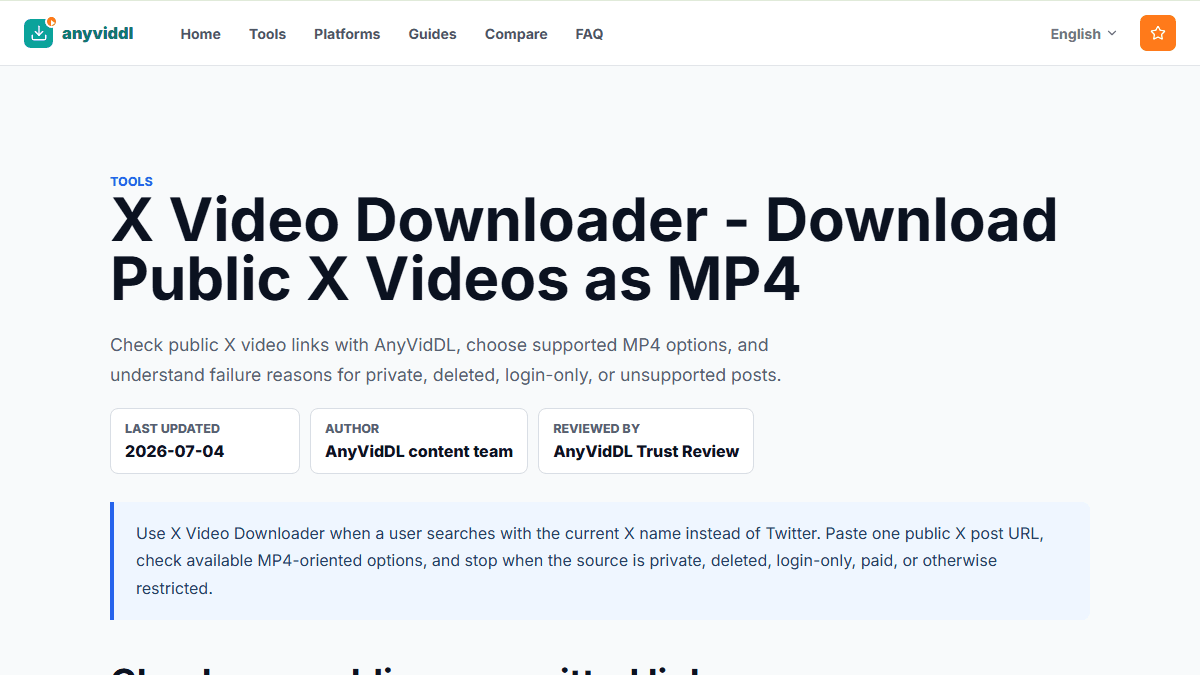
Choose an X video downloader by testing current public X and legacy Twitter URL forms, checking audio and output formats, and requiring clear explanations for private, deleted, or restricted posts. This page is the canonical decision guide for both X and Twitter downloader searches.
Direct answer
Choose an X video downloader by testing current public X and legacy Twitter URL forms, checking audio and output formats, and requiring clear explanations for private, deleted, or restricted posts. This page is the canonical decision guide for both X and Twitter downloader searches.
Evaluation framework for X links
A useful comparison begins with the URL and access state, not a generic tool ranking. Verify that the post is visible without private account state, that it contains downloadable media, and that the intended save is permitted. Then inspect the output rather than trusting a badge such as "HD" or "works everywhere."
The most important signals are current x.com URL handling, legacy twitter.com compatibility, audio presence, playable output, privacy expectations, and a failure message that distinguishes an unsupported format from an access boundary.
User-fit matrix
| Situation | Recommended starting point | Evidence to keep |
|---|---|---|
| One public post | Single-link web check | Original URL, date, returned format |
| Creator backing up owned posts | Test one post, then assess repeated workflow | Ownership context, filenames, failures |
| Editor keeping a permitted reference | Preserve provenance and attribution | Source URL, author, publication date |
| Repeated technical processing | Consider extension, API, or MCP only after validation | Task history, error category, output check |
| Private or restricted post | Stop | Record that access—not format—blocked the task |
AnyVidDL is one possible starting point for supported public-link workflows. The matrix does not imply support for every post type or platform response.
Test before you trust a tool
- Select one non-sensitive public X post you own or have permission to test.
- Try both its current
x.comURL and any legitimate legacy URL form you already have. - Inspect the returned container and available quality instead of assuming MP4 or HD.
- Play the output and check duration, seeking, audio, and visible corruption.
- Repeat with a second public post only if the first result is clear.
- Stop if the source needs credentials, private cookies, paid access, DRM bypass, or another restricted state.
X naming, redirects, and compatibility
Twitter became X, but old links, embeds, search language, and user habits still use both names. Maintaining two nearly identical "best downloader" pages would split the same decision intent and create duplicate content. AnyVidDL therefore uses this page as the primary comparison resource and redirects the older Twitter-specific comparison URL here.
This consolidation does not claim that every historical URL will resolve forever. A legacy post can still be deleted, restricted, malformed, or served through a media response the workflow does not support.
Failure signals that should change the decision
An unavailable post, login requirement, missing media, expired response, separated audio track, or unsupported format calls for diagnosis—not progressively more aggressive tools. A downloader should explain whether the next step is to correct the URL, choose another available rendition, wait for a public replay, or stop because the source boundary cannot be crossed.
Where AnyVidDL does and does not fit
AnyVidDL may fit a public or permitted single-link check when the user values explicit options and failure reasons. It may not fit a private post, removed content, paid or DRM-protected media, unauthorized reuse, attribution removal, or a request to guarantee quality beyond the source. Repeated work should move to extension, API, or MCP only after the single-link workflow is verified.
FAQ
Is an X downloader different from a Twitter downloader?
The search terms differ, but they usually describe the same user decision. Current and legacy URL forms should be tested in one canonical guide rather than supported by duplicate ranking pages.
Why does a public X video have no audio after saving?
Some media responses separate audio and video tracks. The workflow must detect and merge both, and not every source variant is supported.
Can a downloader guarantee the highest quality?
No defensible comparison should guarantee a quality the source does not expose. Check the actual returned renditions.
What information should I keep when reporting a failure?
Keep the public URL, test date, browser or device, visible error, returned formats, and whether audio and video were present.