AnyVidDL API and MCP: Availability and Developer Boundaries
Understand the current AnyVidDL web endpoint, the status of public API and MCP access, and the safeguards required for future automation.
AnyVidDL currently exposes a web download workflow for the site interface, but a public developer API, API-key application flow, SDK, and MCP server are not confirmed as available in this repository as of August 1, 2026. Treat API and MCP as planned developer paths until official documentation and access links are published.
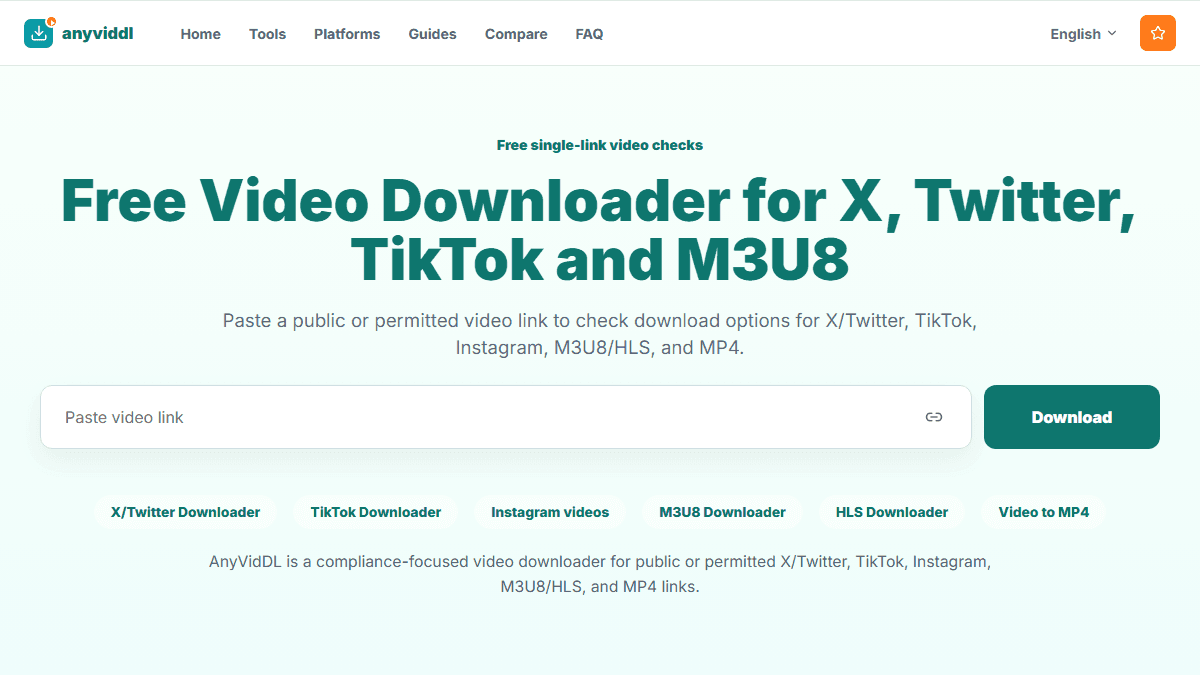
Check one public or permitted link
Paste one supported URL to inspect source files and playlists. Cloud merging, public API and MCP access are not currently available.
Direct answer
AnyVidDL currently exposes a web download workflow for the site interface, but a public developer API, API-key application flow, SDK, and MCP server are not confirmed as available in this repository as of August 1, 2026. Treat API and MCP as planned developer paths until official documentation and access links are published.
What is verified today
The AnyVidDL website uses its own server-side endpoint to support the public web form. That implementation detail does not automatically make the endpoint a stable, documented, or supported developer API.
Developers should use the web workflow for one supported public or permitted link unless the developer page and status page publish current access documentation.
What is not yet confirmed as public
- A developer API reference with a versioned contract.
- A public API-key request and revocation process.
- Published rate limits, quotas, or service-level terms.
- Official SDK packages or code examples.
- An installable AnyVidDL MCP server and tool schema.
Until these items exist, content should not promise production API tasks, audit logs, queue control, or MCP integration as available product features.
Requirements for a future developer API
| Requirement | Why it matters |
|---|---|
| Authentication and key lifecycle | Developers need a supported way to request, rotate, and revoke access |
| Allowed-use policy | Automation must remain limited to public, owned, or permitted sources |
| Versioned request and response schema | Integrations need stable fields and explicit breaking-change rules |
| Rate limits and task states | Clients need bounded retries and clear status handling |
| Refusal reasons | Private, paid, login-only, DRM, and credential-gated sources must stop clearly |
| Privacy and retention | Users need to know what URLs, logs, and outputs are retained and for how long |
Requirements for a future MCP server
An AnyVidDL MCP server would need a published package or repository, a clear tool list, authentication instructions, input and output schemas, refusal categories, logging behavior, and examples that use only public or permitted sources. MCP must not weaken the API's access controls or safety limits.
Current developer next step
Check AnyVidDL Developers and the status page for an official announcement. Do not build against an undocumented website endpoint or assume that a planning page is a production contract.
FAQ
Does AnyVidDL have a public developer API?
A public developer API with documented authentication, limits, SDKs, and an application flow is not confirmed in this repository as of August 1, 2026. The website's internal endpoint should not be presented as a supported public API.
Is there an official AnyVidDL MCP server?
An installable MCP server and public MCP documentation are not confirmed as available. Treat MCP as a planned workflow until official access instructions are published.
What should a future API document?
It should document authentication, allowed use, supported inputs, rate limits, retention, task status, refusal reasons, versioning, and security contacts.
Can API or MCP automation bypass private access or DRM?
No. Automation must preserve the same refusal boundaries for private, paid, login-only, credential-gated, and DRM-protected sources.